
Prepare Your District of SB 865—Without Disrupting the School Day
The Frontline MedED District Compliance & Readiness Program
Powered by American Heart Association RQI
CPR certification is only one part of campus readiness. Frontline MedED helps your district build the training, response team, practiced procedures and AED-readiness processes needed to create a more coordinated cardiac emergency response.
Your district also needs trained personnel, an established cardiac emergency response team, practiced procedures, accessible AEDs and a plan that remains current as staffing and campus needs change.
Frontline MedED helps Texas school districts bring those elements together in a practical readiness program built around their campuses, personnel and instructional schedules.
What the Landon Payton Act Requires
Senate Bill 865—the Landon Payton Act—raises the standard for cardiac-emergency preparedness in Texas schools.
Covered schools must develop and implement a cardiac emergency response plan that includes:
An established cardiac emergency response team
Procedures for activating the response team
Distribution of the plan throughout each campus
Ongoing first-aid, CPR and AED training for appropriate personnel
Annual cardiac-emergency practice drills
Annual review, evaluation and modification of the plan when needed
Coordination with local emergency services
Evidence-based emergency cardiovascular practices
The law also requires designated personnel to receive and maintain CPR and AED certification. These personnel include school nurses, assistant school nurses, athletic coaches or sponsors, physical education instructors, marching band directors, cheerleading coaches and student athletic trainers, along with other personnel identified by the commissioner.
Covered schools must implement the required cardiac emergency response plan no later than the first instructional day of the 2027–2028 school year.
Ready Before it Matters:
Free Cardiac Emergency Resources for Texas Schools
Texas now requires every school district to have a cardiac emergency response plan in place by the first day of the 2027–28 school year. That includes a response team, ongoing CPR and AED training for nurses, coaches and PE staff, and an annual cardiac arrest drill.
We built these free resources to help school nurses, athletic trainers and administrators explain what the law requires, what the research shows, and what it takes to be ready. Download them, share them, and use them in your district.
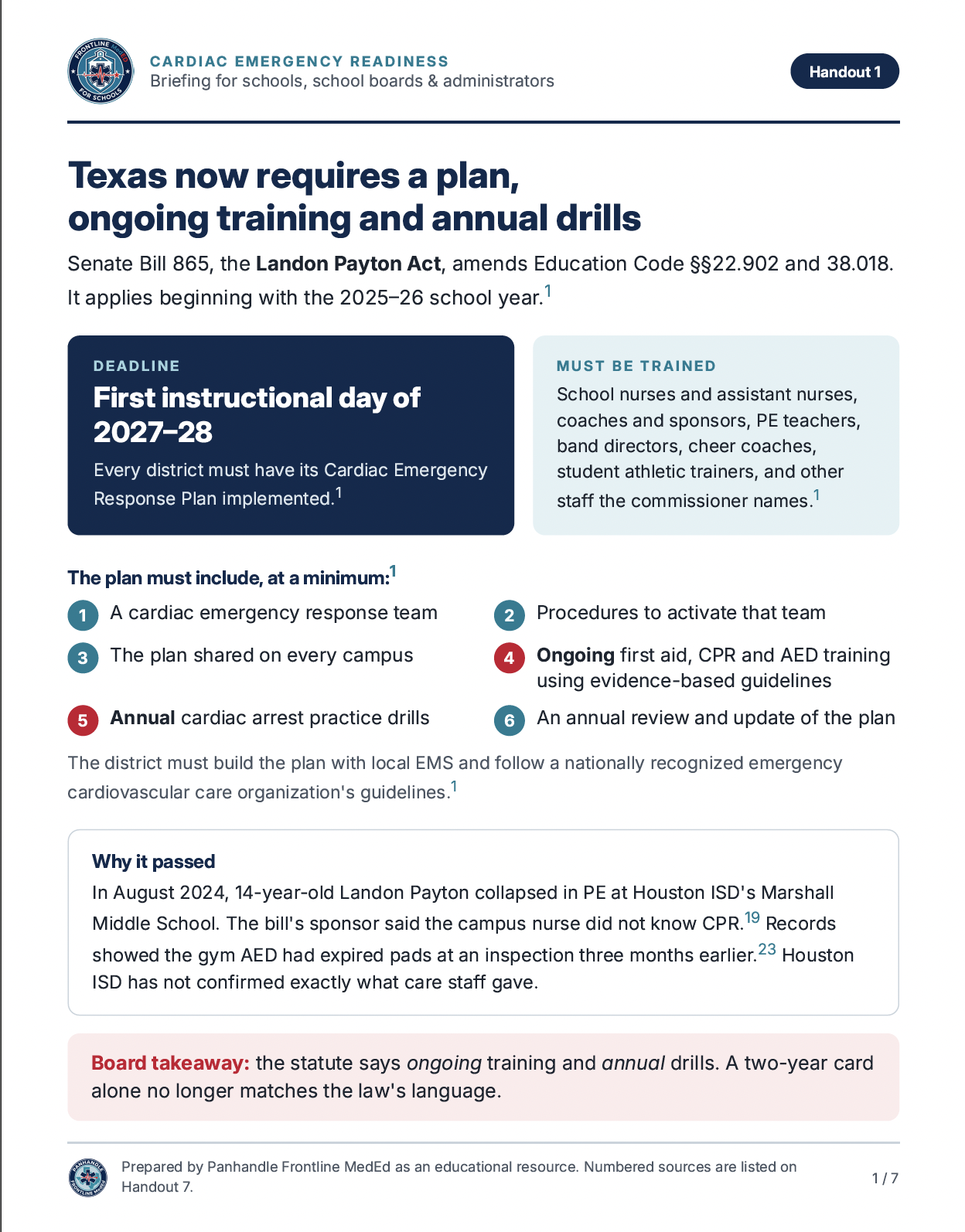
Briefing for Schools, School Boards & Administrators (PDF)
A 10-page packet covering what the law requires, how often cardiac arrests happen on school campuses, why CPR skills fade within months, what compliance looks like, and what has happened when the response failed. Every figure is sourced.
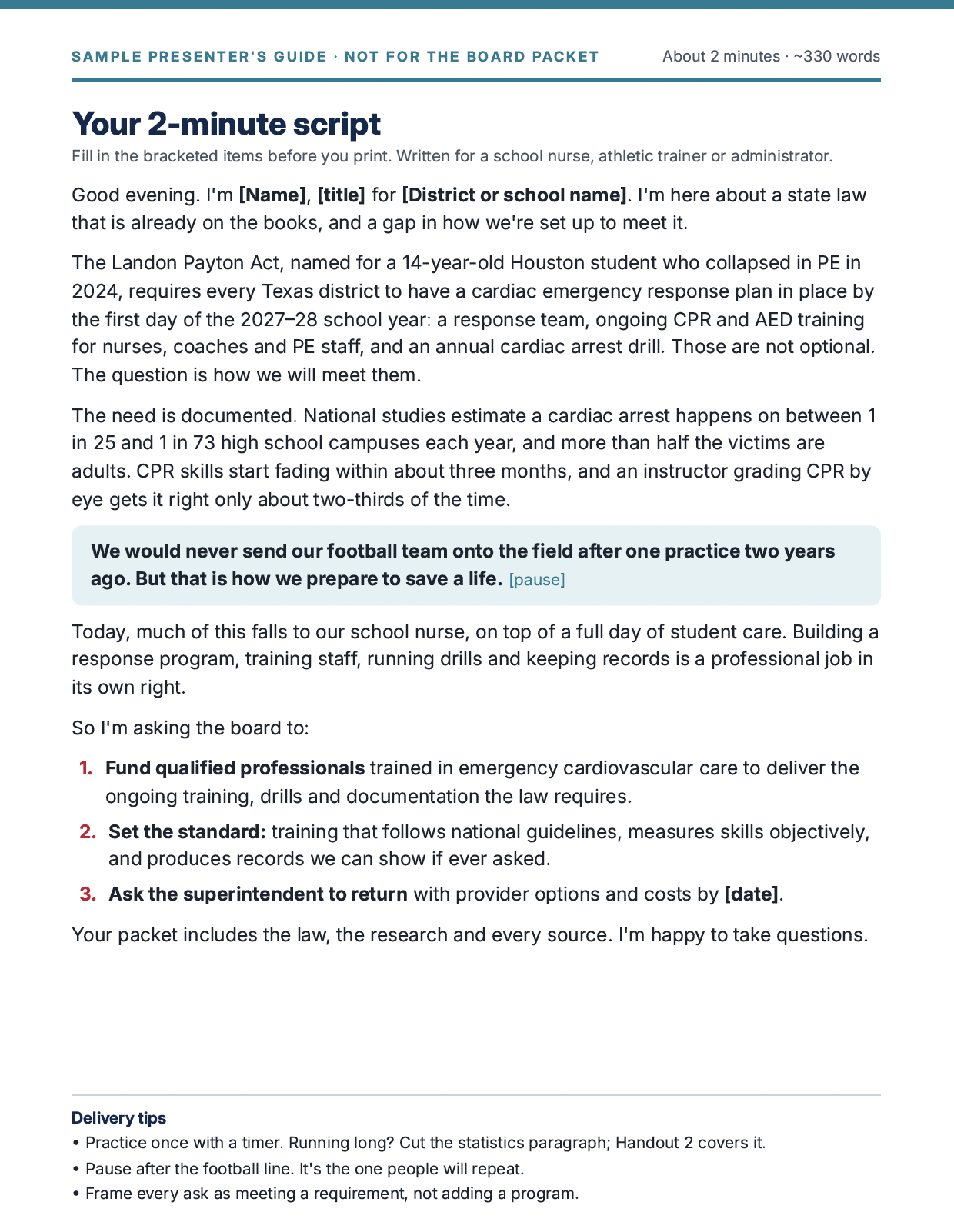
Sample Presenter’s Guide ( PDF)
A 2-minute script and answers to common questions, written for the nurse, athletic trainer or administrator who brings this to district leadership. Fill in your name and district and you’re ready to present.
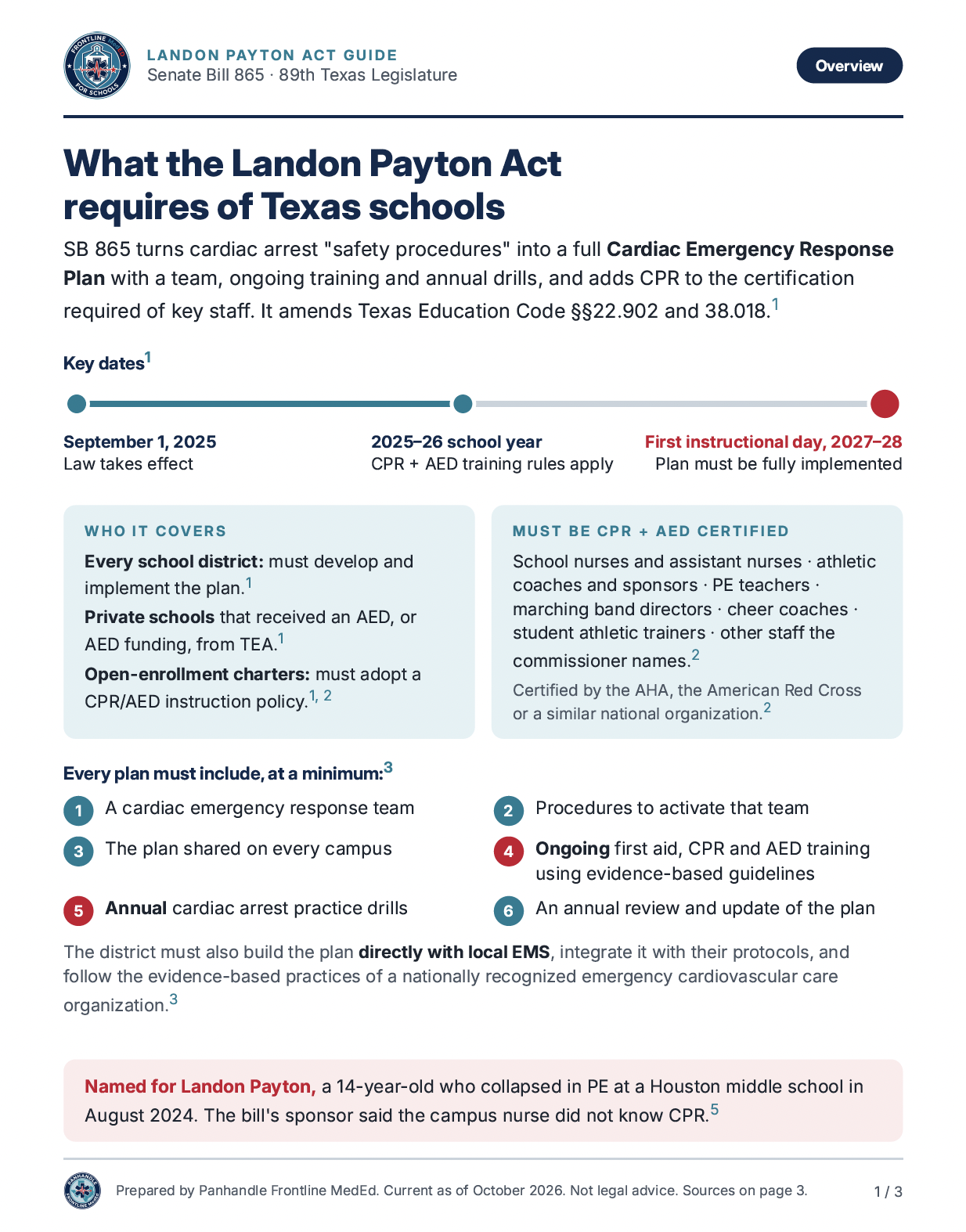
Landon Payton Act Guide (PDF)
What SB 865 requires, what changed from the old law, and a checklist to check your district’s readiness. 3 pages.
These resources are provided for educational purposes and are current as of October 2026. They are not legal advice; consult your district’s counsel about specific requirements.
Understanding the Law Is the First Step. Implementing It Is the Next.
A written plan does not automatically create a coordinated response.
District personnel must understand their responsibilities, maintain critical skills and practice the plan in the environment where an emergency could occur.
That is where Frontline MedED can help.
Built for Your District
No two districts have the same personnel, campuses, AED inventory, emergency procedures or scheduling challenges.
The Frontline MedED District Compliance & Readiness Program is customized around your district rather than sold as a one-size-fits-all package.
RQI-powered recurring CPR skills training serves as the foundation. We then help your district select the readiness services needed to support its personnel, campuses and cardiac-emergency plan.
Your program may include:
RQI-powered recurring CPR and AED skills training
Cardiac Emergency Response Team development
Campus roles and activation procedures
AED inventory and readiness assessments
Quarterly AED-readiness reviews
Annual cardiac-emergency drills
Drill evaluation and after-action reporting
Certification and training oversight
Annual program review and improvement planning
First-aid and supplemental training
Instructor-led or HeartCode Complete certification when appropriate
Transferable training seats for eligible staffing changes
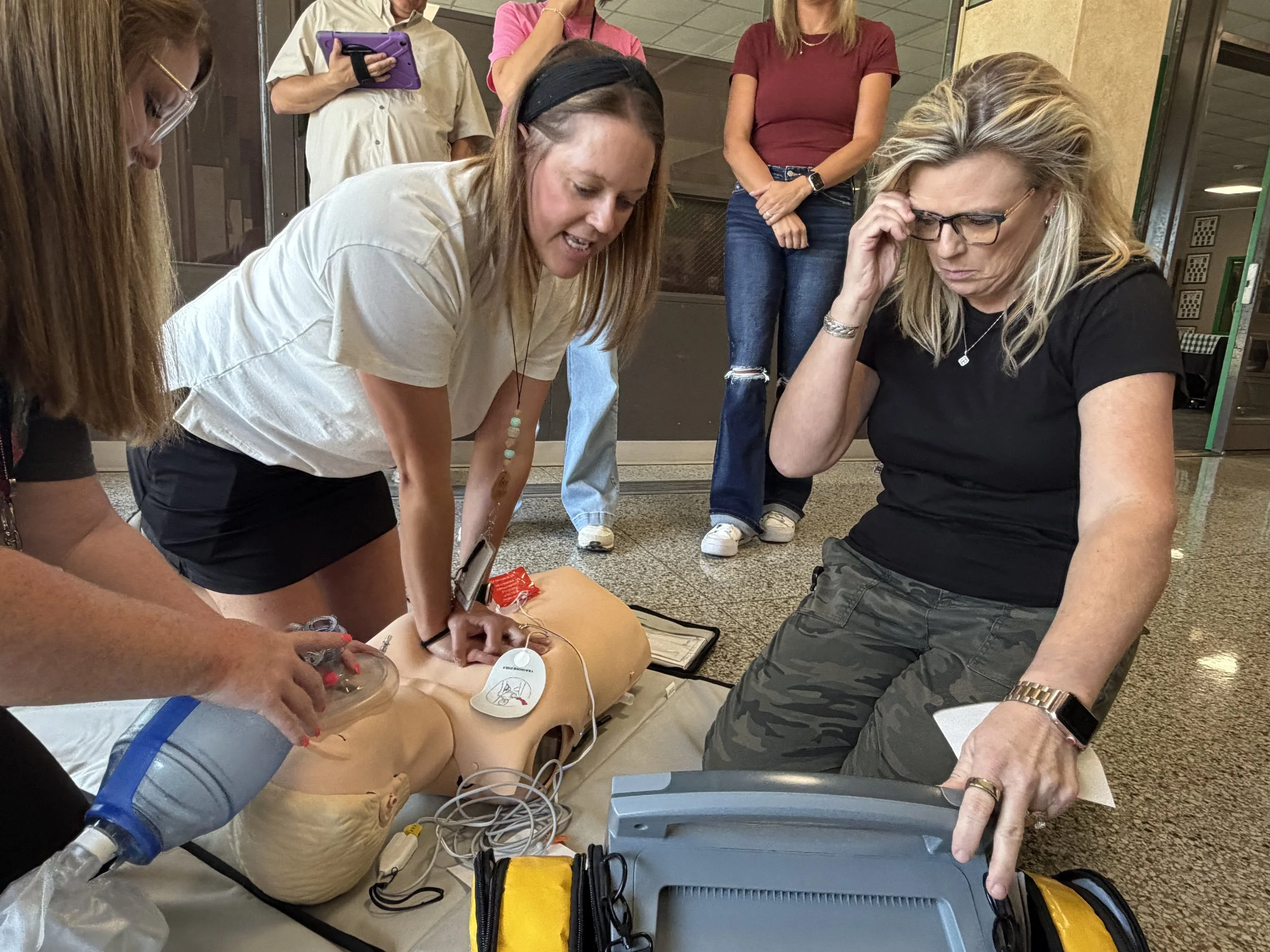
RQI Is the Heart of the Program
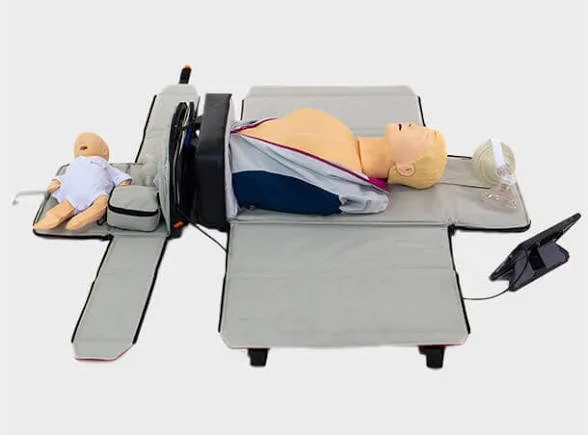
What Is RQI?
RQI stands for Resuscitation Quality Improvement.
The American Heart Association’s RQI program replaces the traditional pattern of completing one CPR course and then going long periods without structured skills practice.
Instead, enrolled participants complete shorter, more frequent cognitive and hands-on activities throughout the year. Skills are performed at an RQI simulation station that provides real-time, objective feedback on important components of high-quality CPR.
This approach is often described as low-dose, high-frequency training.
How RQI Works
1. Complete Initial Enrollment
Eligible participants complete their assigned introductory learning and establish baseline CPR competency.
2. Return for Brief Quarterly Sessions
Participants complete short cognitive and hands-on activities throughout the year rather than waiting until the next traditional renewal cycle.
3. Receive Objective Performance Feedback
The RQI station measures CPR performance and provides immediate audiovisual coaching. Participants can see whether their compressions and ventilations meet the program’s performance standards.
4. Maintain Program Requirements
Eligible personnel who complete their assigned requirements remain current according to the applicable RQI program and credentialing requirements.
Why RQI Works for School Districts
Shorter Training Sessions
Brief recurring sessions can be scheduled around planning periods, professional-development days and normal campus responsibilities.
Less Classroom Disruption
Districts can reduce dependence on lengthy off-site training events that may require substitute teachers, travel and major scheduling changes.
Skills Are Practiced Throughout the Year
Personnel reinforce CPR skills regularly instead of relying entirely on what they remember from a course completed months earlier.
Objective Feedback
Instrumented technology evaluates performance using measurable criteria rather than relying only on subjective observation.
Centralized Oversight
Program records can help administrators monitor assigned training and identify personnel who still need to complete requirements.
Turnover Protection
Eligible program seats remain with the district rather than being permanently attached to one employee. When an enrolled employee leaves, an available seat may be reassigned to an eligible replacement according to program terms.
RQI Maintains Individual Skills. Frontline MedED Builds the Response Around Them.
A coordinated cardiac emergency response requires more than individual CPR performance.
Frontline MedED helps your district connect personnel competency with campus procedures, equipment readiness and team-based practice.
Cardiac Emergency Response Team Development
We work with district and campus leaders to help identify appropriate team members and clarify response responsibilities.
Planning may address:
Who recognizes and activates the emergency response
Who calls 911
Who begins CPR
Who retrieves the AED
Who manages students and bystanders
Who meets and directs responding EMS personnel
Who assumes leadership when a primary team member is absent
How coverage changes during athletics, performances and after-school events
The district retains responsibility for approving personnel assignments, policies and final procedures.
Campus Activation Procedures
We help your district evaluate how the cardiac emergency response team will be activated and how information will move through the campus during a suspected cardiac arrest.
The process may consider:
Classroom and administrative communication systems
Athletic fields and gymnasiums
Portable classrooms
Auditoriums and performance areas
After-hours activities
Substitute and temporary personnel
Access points for emergency responders
Coordination with local EMS protocols
Annual Cardiac-Emergency Drill
Frontline MedED clinical educators can facilitate a realistic annual drill based on the district’s campus layout and response plan.
The exercise may evaluate:
Recognition of possible cardiac arrest
Activation of 911 and the campus response team
Time to begin CPR
Time to retrieve and apply the AED
Team communication
Role clarity
EMS access and handoff
Response coverage when primary personnel are unavailable
Following the drill, Frontline MedED can provide an after-action summary identifying observed strengths, response gaps and opportunities for improvement.
Training and drills cannot guarantee an emergency outcome, but they can help identify weaknesses before an actual emergency occurs.
Quarterly AED-Readiness Reviews
An AED can only help if it is accessible and ready for use.
Quarterly AED-readiness reviews may include:
Device status indicators
Pad expiration dates
Battery expiration or replacement dates
Pediatric pad availability where appropriate
Cabinet condition and accessibility
Signage and location visibility
Inspection documentation
Changes in building use or AED placement
Equipment concerns requiring district follow-up
Quarterly reviews are a Frontline MedED program enhancement and should not be presented as a specific quarterly requirement of SB 865.
The district remains responsible for equipment maintenance, manufacturer requirements and final corrective action.
Annual Program Evaluation
Cardiac readiness should evolve as campuses, personnel and equipment change.
An annual review may evaluate:
Training and certification status
Response-team membership
Personnel turnover
Drill performance
Corrective actions
AED inventory and readiness
Campus construction or layout changes
After-school and athletic coverage
Areas of the plan requiring modification
This review can help district leaders determine priorities for the following year.
A Program Designed Around Your Actual Needs
Program pricing is not based on a single, fixed package.
Following a district consultation, Frontline MedED develops a proposed scope based on factors such as:
Number of campuses
Number of active RQI seats
Number and location of AEDs
Existing response plans and procedures
Response-team development needs
Number of annual drills requested
Desired frequency of AED-readiness reviews
Supplemental training requirements
Desired level of ongoing Frontline MedED support
Your district receives a defined scope, implementation schedule and transparent proposal before services begin.
A Simpler Path to Districtwide Readiness
1. Schedule a District Consultation
Tell us about your campuses, personnel, AED inventory, existing training and current cardiac-emergency procedures.
2. Receive a Customized Readiness Plan
We identify an appropriate mix of RQI seats, team-development support, drills, AED reviews and supplemental training.
3. Implement, Practice and Improve
Frontline MedED helps your district roll out the selected services, evaluate performance and strengthen readiness over time.
Important Information
Frontline MedED provides education, training and implementation support. Information on this page is provided for general educational purposes and does not constitute legal advice.
Services cannot guarantee statutory compliance, emergency outcomes or the performance of any individual responder. District leaders should review applicable law, official agency guidance, local policy, equipment-manufacturer requirements and legal responsibilities with appropriate counsel and authorities.
RQI and HeartCode are registered programs or trademarks associated with the American Heart Association and their respective program partners. Program availability, eligibility, credentialing and requirements depend on the selected course and service configuration.
Official Information
Texas Legislature: Senate Bill 865—the Landon Payton Act
Texas Education Code: Cardiac Emergency Response Plan
American Heart Association: Resuscitation Quality Improvement Program