
Your School Is Prepared for Cardiac Arrest—but Can You Prove It in Court?
What real cases reveal about emergency plans, staff training, AED readiness, documentation, and preventable gaps.
A Low Frequency Event With High Consequences
When school begins after summer break, cardiac arrest may not be at the top of an administrator’s list. Budgets are tight, training time is limited, and the event itself is uncommon. Yet uncommon does not mean unforeseeable.
A peer-reviewed U.S. study of emergency medical services-treated cardiac arrests in Seattle and King County estimated that an event occurred annually at approximately one in every 125 high schools and one in every 200 preschools through middle schools. For an individual high school, one event per 125 school-years is an annual probability of about 0.8 percent. If that rate remained constant, the cumulative probability would be about 7.7 percent over a decade.[1]
The district-level estimates below are mathematical extrapolations from the study’s overall rate of one event per 111 schools annually. They are planning estimates, not predictions for a particular Texas district.
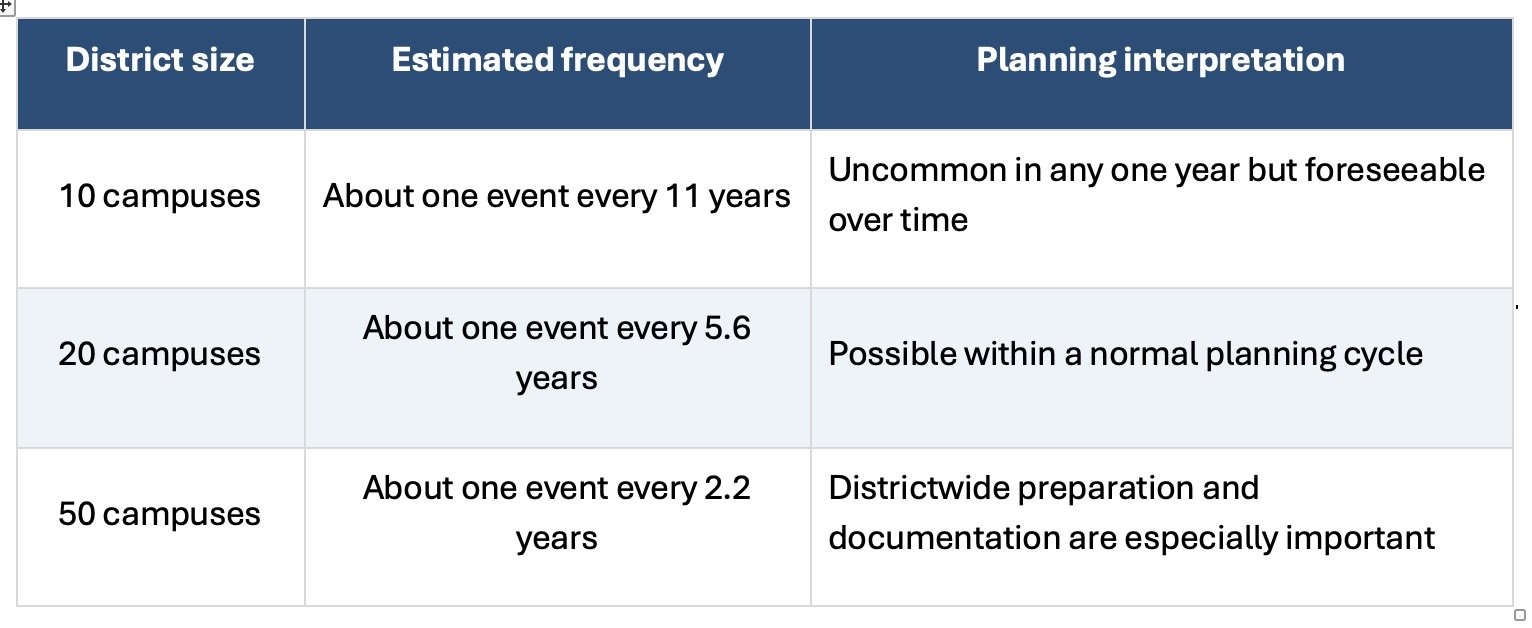
Estimated School Based Cardiac Arrest Frequency by District Size
Certification and Preparedness Are Different
Schools commonly rely on instructor-led CPR courses and periodic recertification. The required training interval and the employees who must be certified depend on the person’s role, the credentialing program, and applicable law. For this discussion, assume that the instruction follows the certifying organization’s standards and that participants earn valid credentials. That proves course completion. It does not, by itself, prove that the entire campus can carry out a coordinated response.
The distinction is not about staff competence or commitment. Skills that are rarely used can deteriorate. A school must also answer operational questions that a certification card cannot address: Who recognizes the emergency? Who calls 911? Who begins compressions? Who retrieves the AED? Can the device reach every occupied area quickly? Who meets emergency responders and directs them to the patient?
Texas Responded With the Landon Payton Act
Texas strengthened its school cardiac emergency requirements in 2025 by enacting Senate Bill 865, the Landon Payton Act. The legislation followed the August 2024 death of 14-year-old Landon Payton. Landon experienced a medical emergency and collapsed during physical education at Marshall Middle School in Houston. He later died at a hospital. Questions about the school’s response and the availability of a working AED brought statewide attention to cardiac preparedness.
Important facts remain unresolved. The Harris County medical examiner classified Landon’s cause and manner of death as undetermined. Publicly available records do not establish that an AED malfunction caused his death or that a different response would have changed the outcome.[2]
The Landon Payton Act requires covered schools to develop a cardiac emergency response plan with a response team, activation procedures, campuswide distribution, ongoing first-aid, CPR, and AED training for appropriate personnel, annual practice drills, coordination with local emergency services, and annual evaluation of the plan. The law identifies personnel who must maintain CPR and AED certification, including school nurses, coaches, physical education instructors, marching band directors, cheerleading coaches, and student athletic trainers. Covered schools must implement the required plan no later than the first instructional day of the 2027–2028 school year.[3]
Compliance is necessary, but administrators should also be able to show how they evaluated performance. A drill record should document response times, participant roles, equipment access, observed problems, and corrective actions. An objective outside evaluation can add useful evidence, but the law does not require districts to outsource their drills.
What Courts and Settlements Have Shown
A California jury awarded $15 million after 13-year-old Maxwell Tillinghast died following cardiac arrest during physical education. The school had an AED in its main office, and teachers had received AED training, but the teachers responding to Maxwell did not know the device was there. The California Court of Appeal allowed the verdict to stand in 2025.[4]
Other school-related cardiac emergency claims have produced substantial settlements. A Connecticut town and school district agreed to a $20 million settlement following the death of five-year-old Romeo Pierre Louis.[5] Federal Way Public Schools in Washington agreed to a $5.25 million settlement following the death of 16-year-old student-athlete Allen Harris.[6] A Virginia school board settled a claim for $1.3 million after a 15-year-old student died during gym class.[7]
These cases must be described accurately. A jury found negligence in the Tillinghast case. Settlements resolve disputed claims and do not necessarily establish negligence or admit liability. The cases nevertheless illustrate the scrutiny placed on AED access, emergency recognition, staff actions, training, and response documentation after a serious event.
Practice the Plan Where It Must Work
I was a high school senior when the Columbine High School shooting occurred. Near the end of that school year, my school conducted its first lockdown drill. When the alarm sounded, some people reacted as though it were a fire drill, others thought it signaled a tornado drill, and some did not know what to do. The situations are very different, but the preparedness lesson is similar: good intentions do not produce a coordinated response unless people have practiced their roles.
Cardiac emergency drills should test realistic conditions. An AED must be available when the building is occupied, including during athletic events and after-school activities. Staff should know its location, and designated responders should be physically able to perform their assigned tasks. The plan must also include redundancy. A response cannot depend entirely on one nurse, coach, or administrator who may be absent or working elsewhere on campus.
The American Heart Association’s school cardiac emergency response materials recommend drills, debriefing, and coordination with local EMS. Its model plan calls for at least two successful cardiac emergency response drills each year and defines successful completion as completing the full drill in five minutes or less.[8] Schools should also consider ambulance availability, local response times, building access, remote athletic fields, portable classrooms, and the personnel present outside normal school hours.
Use Frequent Practice and Objective Feedback
I have taught CPR for more than 25 years. I have watched educators, coaches, trainers, and medical professionals struggle with skills they do not use regularly. That does not make them incompetent. It shows why periodic course completion should be supported by shorter, more frequent practice.
The American Heart Association’s Resuscitation Quality Improvement Program uses quarterly training and instrumented simulation stations that provide real-time feedback and retain learner performance data.[9] Frontline MedED can help schools apply a low-dose, high-frequency approach to skills practice and build realistic cardiac emergency exercises around their campus. Training and documentation cannot guarantee a clinical outcome or eliminate legal risk, but they can help a school identify weaknesses before an actual emergency.
Questions Every School Should Be Able to Answer
· Can staff recognize possible cardiac arrest, including seizure-like activity and abnormal gasping?
· Can someone call 911 while another responder begins CPR?
· Can an AED reach any regularly occupied campus location within the response plan’s target time?
· Are the AED pads and batteries current, and are inspection records available?
· Who leads the response if the nurse or primary coordinator is absent?
· Who meets EMS and guides responders to the patient?
· Does the plan cover athletic fields, portable classrooms, performances, and after-school events?
· Are drills timed, evaluated, documented, and followed by corrective action?
Be Ready Before It Matters
No school can prepare for every possibility. It can, however, build a response plan, practice it under realistic conditions, measure performance, and correct identified weaknesses. The goal is not flawless performance in a classroom exercise. The goal is a reliable response when a student, employee, parent, or visitor needs immediate help.
Can your school show that its training and cardiac emergency plan work in practice? If you are uncertain, contact Frontline MedED for a consultation about training, drills, AED readiness, and performance documentation. These services support a school’s preparedness efforts but do not replace legal advice or guarantee compliance or outcomes.
Sources
1. Lotfi et al. Cardiac Arrest in Schools. Circulation. 2007. Source
2. Houston Chronicle. Autopsy report reveals clues in HISD student’s undetermined death. June 13, 2025. Source
3. Texas Legislature. Senate Bill 865 enrolled text. Landon Payton Act. Source
4. Tillinghast v. Los Angeles Unified School District. California Court of Appeal. 2025. Source
5. CT Insider. Twenty million dollar settlement in the death of Romeo Pierre Louis. July 15, 2026. Source
6. FOX 13 Seattle. Federal Way Schools settlement with the family of Allen Harris. Source
7. Virginia Lawyers Weekly. Teen died in gym class from a cardiac condition. May 16, 2022. Source
8. American Heart Association. Cardiac Emergency Response Plan and Protocol for Schools. Source
9. American Heart Association. Resuscitation Quality Improvement Program. Source